Call us now:

GAINESVILLE • ALACHUA COUNTY • NORTH FLORIDA
Gainesville Domestic Violence Defense Lawyer
Experienced criminal defense when allegations affect your liberty, home, family, and future.
Board Certified
Criminal Trial Lawyer
20+ Years
Criminal-Defense Experience
Domestic Violence
No-Contact Orders • Injunctions
Florida Domestic Violence Defense Resources
Florida Domestic Violence Resource Center
Explore Landsman Law’s guides to domestic battery, assault, self-defense, injunctions, arrest procedures, and related Florida domestic-violence issues.
What Makes a Florida Domestic Violence Case Different?
Under § 741.28, Florida Statutes, “domestic violence” is a legal designation that can apply to assault, battery, stalking, false imprisonment, and other qualifying criminal offenses committed between family or household members.
The relationship between the parties matters. Spouses, former spouses, people related by blood or marriage, people who live or previously lived together as a family, and people who share a child may fall within the statutory definition.
Domestic-violence cases can also involve procedures and consequences that arise immediately after arrest—before guilt has been determined—including first appearance, no-contact conditions, and possible parallel injunction proceedings.
After an Arrest
What Happens Immediately After a Domestic Violence Arrest?
Under § 741.2901, a person arrested for an act of domestic violence is held until brought before the court for consideration of bail. The judge considers safety when setting conditions of release.
Those conditions may affect contact with the alleged victim, access to a home, weapons, travel, children, pets, vehicles, medication, and personal property while the criminal case is pending.
Read: What Happens After a Domestic Violence Arrest? →No-Contact Orders
A defendant should not assume that the alleged victim can personally cancel or override a no-contact condition imposed by the judge. The written court order controls unless and until the court modifies it.
Even voluntary calls, texts, invitations to return home, or a statement that the case has been “dropped” do not automatically authorize prohibited contact.
Can the Alleged Victim Drop the Charges?
Generally, the State Attorney controls the criminal prosecution. A recantation, affidavit of non-prosecution, continued contact, or changed account may affect the evidence, but does not automatically dismiss the case.
Evidence Review
Evidence in a Domestic Violence Case
Domestic violence cases frequently depend on several forms of evidence. The defense should compare the initial accusation with recordings, photographs, communications, witness accounts, and the physical scene whenever possible.
911 Calls and Dispatch AudioInitial descriptions, timing, background sounds, statements made during the call, and differences from later accounts.
Body-Camera VideoStatements, demeanor, injuries, the condition of the scene, officer observations, and interactions between witnesses.
Photographs and Injury EvidenceImages of injuries, lack of visible injury, property damage, clothing, and the progression of marks or bruising over time.
Text Messages and EmailsCommunications before and after the incident that may provide context, identify motive, contradict allegations, or show continued contact.
Digital and Location EvidencePhone data, timestamps, social media, surveillance footage, location information, and other records that can help reconstruct events.
Independent WitnessesNeighbors, family members, friends, bystanders, or other witnesses who observed the encounter or its immediate aftermath.
Prior and Inconsistent StatementsDifferences among 911 calls, bodycam interviews, written statements, injunction allegations, depositions, and hearing testimony.
Scene and Physical EvidenceDamage, objects, clothing, injuries to both parties, and the physical layout of the location where the incident allegedly occurred.
Defense Analysis
Defenses to Domestic Violence Charges
The available defenses depend on the charged offense, the evidence, the relationship between the parties, and the circumstances of the encounter.
Self-DefenseWho initiated force, whether a threat was imminent, proportionality, injuries, video, witness testimony, and other justification evidence.
Defense of Another PersonWhether force was lawfully used to protect another person from an imminent use of unlawful force.
Insufficient ProofAn arrest does not establish guilt. The State must prove each element of the charged offense beyond a reasonable doubt.
Conflicting or Unreliable StatementsCredibility, corroboration, motives, timing, omissions, and contradictions with objective evidence can become central issues.
Accidental or Unintentional ContactSome offenses require intentional conduct. The surrounding circumstances may support accident rather than a criminal touching or striking.
Identification and AttributionThe defense may dispute who caused an injury, made a statement, sent a communication, or committed the alleged act.
Evidence Contradicts the AllegationVideo, photographs, location records, medical evidence, witness testimony, or the physical scene may conflict with the accusation.
Constitutional and Suppression IssuesStatements, searches, seizures, warrants, phone evidence, and other police conduct may require constitutional review.
Competing Complaints and the Primary Aggressor
Domestic violence calls sometimes involve allegations by both parties. Section 741.29 directs officers receiving competing complaints to evaluate them separately and attempt to determine the primary aggressor rather than automatically arresting both people.
That makes injuries to both parties, body-camera footage, photographs, witness statements, the sequence of events, and self-defense evidence particularly important.
Domestic Violence Injunctions and Criminal Charges Are Separate
A petition for an injunction under § 741.30 is a separate civil proceeding. The same allegations can therefore produce both a criminal case and an injunction case.
Testimony, text messages, recordings, photographs, admissions, and witness credibility may overlap between the proceedings.
Florida Domestic Violence Penalties and 2026 Changes
The possible punishment depends on the underlying offense. Domestic battery can be a misdemeanor, while aggravated battery, domestic battery by strangulation, false imprisonment, aggravated assault, aggravated stalking, child abuse, and other offenses may be felonies.
Under § 741.283, a person adjudicated guilty of a crime of domestic violence who intentionally caused bodily harm is subject to specified minimum county-jail terms unless sentenced to a nonsuspended term in state prison. Higher minimums apply when the offense occurs in the presence of a qualifying child under 16.
§ 741.281 addresses batterers’ intervention program and probation requirements in qualifying cases.
A significant 2026 change appears in § 741.2801. For qualifying new domestic-violence offenses committed by a person with a prior domestic-violence conviction, the statute can reclassify the degree of the new offense. The statute contains definitions and exceptions that must be applied to the actual charge and record.

Gainesville • Alachua County
Local Court Experience Matters
Domestic-violence criminal cases in Gainesville proceed through the Alachua County criminal-court system and can involve immediate release conditions, no-contact orders, witness issues, and related injunction proceedings.
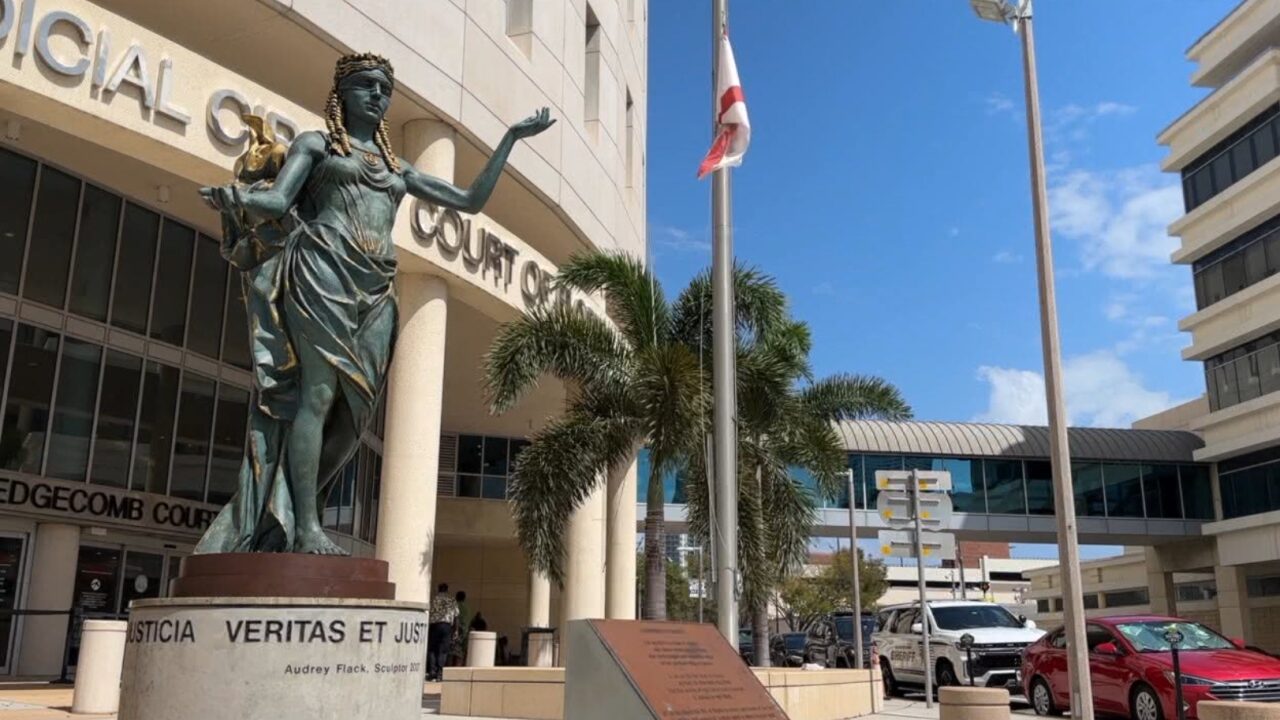
Photo: Alachua County Courthouse Criminal Justice Center, Gainesville, Florida. Ebyabe / Wikimedia Commons. Attribution required under the file’s Creative Commons license.
Domestic Violence Defense in Gainesville, Alachua County & North Florida
Domestic violence investigations in Gainesville may involve the Gainesville Police Department, Alachua County Sheriff’s Office, University of Florida Police Department, or another agency. A local arrest may involve booking at the Alachua County Jail followed by first appearance and judicial release conditions.
Landsman Law also represents clients in Bradford, Gilchrist, Levy, Union, Columbia, Marion, and Putnam Counties.
Why Choose Landsman Law?
Matt Landsman is a Board Certified Criminal Trial Lawyer with more than 20 years of criminal-law experience. His practice includes contested hearings, jury trials, witness examination, self-defense claims, constitutional litigation, and defense of misdemeanor and felony charges.
The defense should be based on the actual evidence, the governing law, and the procedural posture of the case—not assumptions arising from the accusation.




Frequently Asked Questions About Florida Domestic Violence Cases
Will I stay in jail after a domestic violence arrest?
A defendant arrested for an act of domestic violence is held until brought before the court for consideration of bail. Release conditions may then be imposed.
Can my spouse or partner drop the charges?
Not automatically. The State Attorney controls the prosecution. A recantation or request for dismissal can matter, but does not itself terminate the criminal case.
Can I contact the alleged victim if they contact me first?
Not if a court order prohibits contact. The written order controls unless and until the judge modifies it.
Can a no-contact order be changed?
Potentially. Counsel may ask the court to modify release conditions. The existing order should be followed until it is changed.
What if I was defending myself?
Self-defense can be a complete defense when supported by the facts and Florida law. Evidence about who initiated force, injuries, witnesses, and video can be critical.
What if the alleged victim changes the story?
A changed account may matter, but it should be compared with 911 calls, bodycam, photographs, texts, prior statements, and other evidence.
Is an injunction the same as the criminal case?
No. An injunction under § 741.30 is a separate civil proceeding, although evidence and testimony can overlap.
Does a prior domestic violence conviction matter under 2026 law?
Potentially. Section 741.2801 provides reclassification for qualifying new domestic-violence offenses when a prior domestic-violence conviction exists, subject to its terms and exceptions.
Speak With a Gainesville Domestic Violence Defense Lawyer
If you have been arrested, accused of domestic battery, placed under a no-contact condition, or are facing a related domestic-violence allegation, Landsman Law can review the evidence and available defense options.
Call (352) 664-9671 for a consultation.
Prior results do not guarantee a similar outcome.